Decoding Mexico's Hyperlocal Security Crisis
The story of the mayor of Salamanca reveals how localized Mexico’s security crisis can be within the current context of US-Mexico relations.

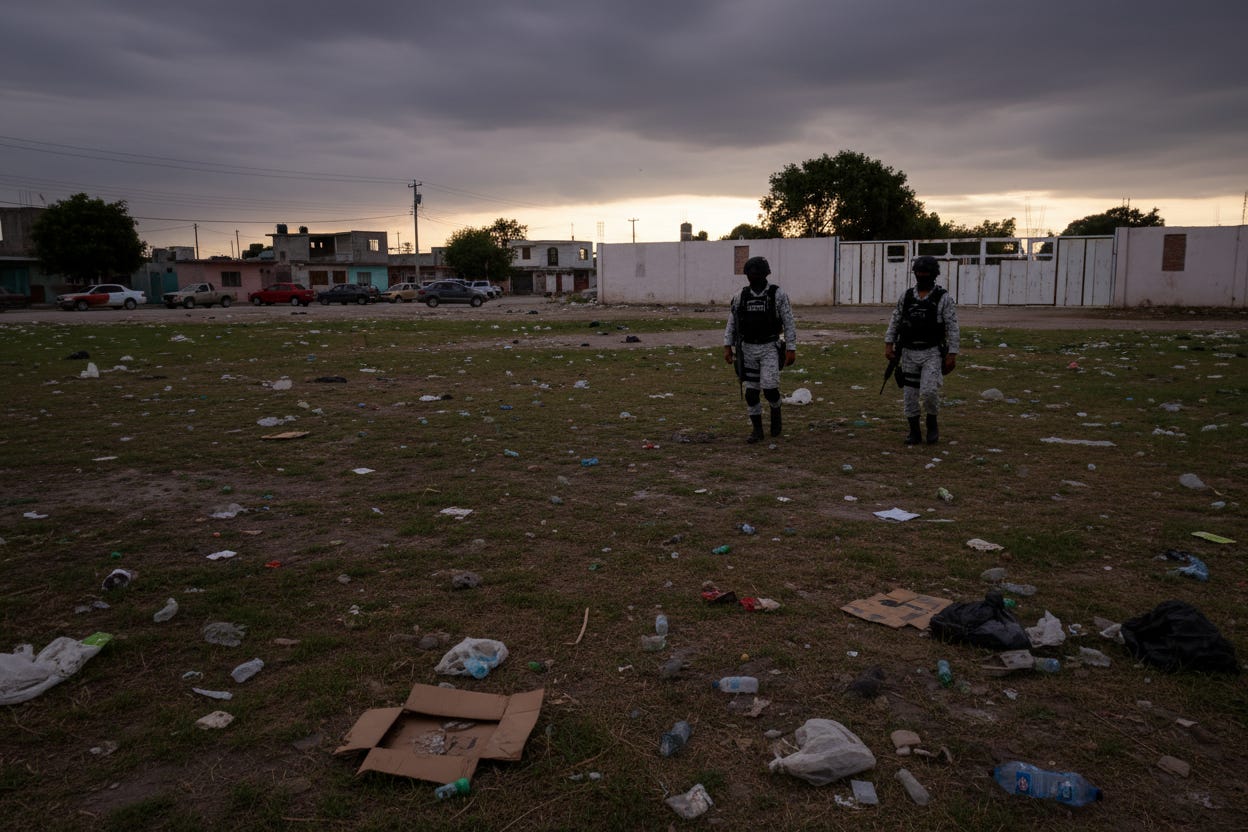
César Prieto stood in front of cameras on Monday morning, 27 January 2026, knowing his words would reach the president—but doubting whether she would answer. The mayor of Salamanca, Guanajuato, had spent Sunday night at the scene: a blood-stained football pitch in the Loma de Flores neighborhood where at least eleven people had been killed and a dozen more wounded. Families had stayed after an amateur match to drink beer and talk. Then, gunmen arrived and fired at least 100 shots into the crowd.
Prieto called it what it was: part of a “crime wave” overwhelming his city. He appealed directly to President Claudia Sheinbaum for help. By Monday afternoon, Sheinbaum had held her daily press briefing. She did not mention Salamanca. She did not mention Prieto. Governor Libia Dennise García promised that “security in the region has been reinforced.” But Prieto knew what reinforcement meant in Guanajuato—announcements after massacres, coordination meetings between agencies, and then another massacre.
The question wasn’t whether violence would return to Salamanca. It was who would be held responsible when it did.
For Prieto, the massacre at Cabañas was the latest expression of a territorial contest that has made Salamanca one of Mexico’s most violent cities today. The gunmen who opened fire Sunday night were operating within the rivalry between the Jalisco New Generation Cartel (CJNG) and the local Santa Rosa de Lima Cartel (CSRL). That rivalry isn’t primarily about drug trafficking. It’s about fuel.
Salamanca is home to one of Mexico’s largest oil refineries, operated by state-owned Pemex. For years, both CJNG and CSRL have tapped Pemex pipelines to steal fuel, a practice known as huachicoleo, and sell it on black markets. The Mexican government cracked down on fuel theft starting in 2019, partially disrupting CSRL’s primary revenue stream. Perceiving CSRL’s weakness, CJNG moved in. What followed was a grinding territorial war fought in neighborhoods like Loma de Flores, where the football pitch became a killing ground.
Prieto governs a city where criminal competition over state resources has become indistinguishable from attacks on civilian life. The families drinking beer after Sunday’s match weren’t targeted because they were involved in fuel theft. They were targeted because Salamanca itself is contested territory, and massacres send messages about who controls public space. The mayor can appeal to the president, but he cannot stop pipelines from being tapped, cannot arrest cartel leaders operating across state lines, and cannot deploy the force required to secure a city where two criminal organizations treat refinery access as worth killing for.
Governor García promised Monday that security had been “reinforced.” But reinforcement in Guanajuato means coordination meetings between municipal, state, and federal agencies—not operational or tactical reinforcement. The day before the Cabañas massacre, five men were killed, and one was abducted in Salamanca. The violence continued because the underlying contest over fuel theft and territorial dominance remained unresolved. Prieto’s appeal to Sheinbaum went unanswered, not because she didn’t care, but because the system is designed to diffuse rather than concentrate responsibility.
What Prieto experienced in Salamanca reveals a mechanism at the heart of Mexico’s security crisis: the state has learned to manage violence politically rather than operationally. His unanswered appeal to Sheinbaum was the system working as designed, intentional or not. When massacres happen in cartel-contested territories, officials announce “reinforcement” and “coordination,” but these terms describe meetings between agencies, not operational control over territory. This hyperlocal gap between announcement and any sort of positive outcome is where cartels thrive.
This gap matters because it exposes how territorial contests over state resources, Pemex fuel in Salamanca’s case, create sovereignty vacuums that no single level of government claims responsibility to fill. Prieto lacks the authority and resources to confront CJNG and CSRL. Governor García can promise decisive action, but defers to federal coordination. Sheinbaum can avoid mentioning Salamanca entirely because the violence falls under state jurisdiction. The result is a system where everyone shares responsibility. But no one owns it.
Security “reinforcement” has become a lagging indicator; it is a signal that territory has already been lost to a cycle of massacre, press conference, and the next massacre. The real risk isn’t not being caught in a crossfire; this rarely happens. The risk is operating in zones where the accountability chain has broken entirely, where criminal organizations’ competition for resources demonstrates that the state’s presence is optional. Prieto’s unanswered appeal is the diagnostic signal: when a mayor publicly admits powerlessness, and the president remains silent, the sovereignty vacuum is set.
As of 29 January 2026, César Prieto is still waiting for an answer. In the days since the Cabañas massacre, “reinforced security” arrived in Salamanca in the form of patrols and checkpoints. They are visible symbols of state presence that do nothing to dismantle the fuel-theft networks that drive violence. The families in Loma de Flores are left to navigate a reality in which a Sunday afternoon at the football pitch is no longer safe, and in which their mayor’s public appeal for help was met with crickets.
Prieto’s story underscores how many local leaders in Mexico experience the public security crisis that most of us just read about from afar. We see a clear message when a local official publicly admits he cannot protect his city, when the governor promises action that means coordination rather than control, and when the president says nothing at all. The system has learned to manage massacres as political liabilities, not operational failures.
Whether it’s Mexico or elsewhere in Latin America, Southern Pulse has the experience, network, and relationships to answer your most challenging strategic questions.