

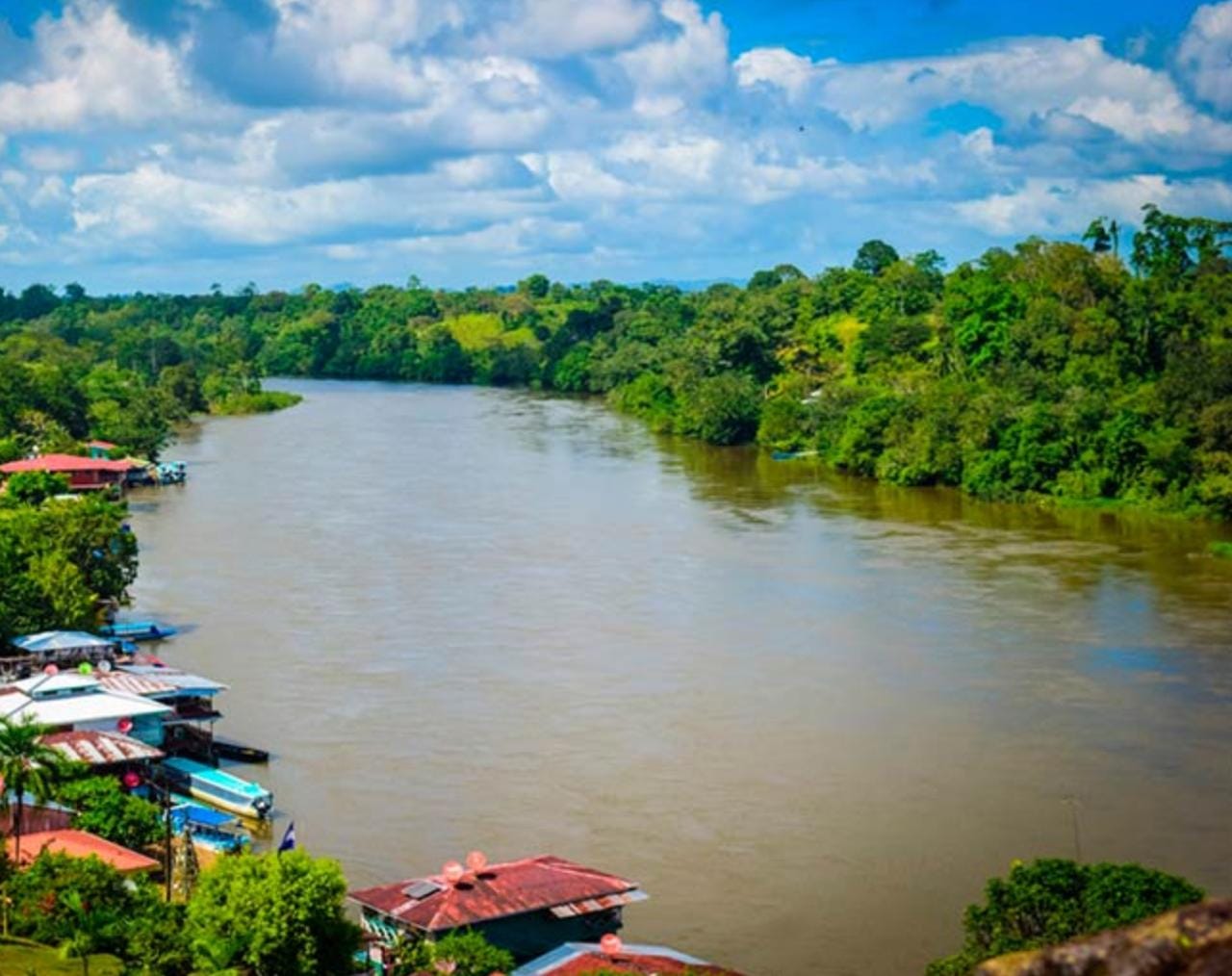
The phone call came in late 2018 — a warning that the Ortega regime was preparing to arrest him. Amaru Ruiz, biologist and director of Fundación del Río, left Nicaragua with what he could carry. The regime moved quickly: it cancelled his organization’s legal status, seized its offices on the Río San Juan, froze its international funds, and in 2023 stripped Ruiz of his Nicaraguan citizenship. What it could not confiscate was his research.
From Costa Rica, Ruiz rebuilt Fundación del Río as an exile operation and kept his attention fixed on the Indio Maíz Biological Reserve and the territory flanking the San Juan River. What he documented over the following years was a systematic dismantling of the regulatory architecture that had once, however imperfectly, governed Nicaragua’s extractive sector.
The Ortega-Murillo regime moved in stages.
First, it dissolved more than 160 environmental organizations, eliminating independent oversight of protected areas.
Next, it rewrote the environmental evaluation law to remove consultation requirements that had applied to non-indigenous territories.
Then, it transferred the General Directorate of Mines — already sanctioned by the US Treasury in October 2022 — to the Attorney General’s Office, burying concession contracts from public view.
Finally, it opened the door.
Between 2021 and 2026, the regime granted 72 mining concessions across 16 Chinese companies, covering more than one million hectares — 8.5% of Nicaraguan territory. Concessions reached into the Río San Juan Biosphere Reserve. Some sat 300 meters from the river that forms the border with Costa Rica.
Ruiz identified what those companies actually were.
None held recognized track records in mining operations.
None were listed on Chinese stock exchanges.
All were recently established.
Their function, as Ruiz explained in interviews with Confidencial, was intermediation — purchasing raw ore, smelting it, refining it, and exporting it. Thomas Metal, the largest concession holder with 17 lots covering more than 228,000 hectares, exemplified the model: it did not extract gold. It bought gold. In January 2026, it received a concession transferred from Compañía Minera Internacional, a firm sanctioned by the US Treasury in 2024 for generating revenue for the Ortega-Murillo regime.
The numbers confirmed what Ruiz’s structural analysis suggested. Nicaragua’s official gold production in 2024 stood at 12.5 tons. Its gold exports that year reached nearly 20 tons. The seven-ton gap had to come from somewhere. Nicaragua is a historically known corridor for Venezuelan gold laundering, but smuggling routes have shifted.
Ruiz’s work pointed to Costa Rica.
Across the San Juan River, on Conchuditas hill in Costa Rica’s San Carlos canton, coligalleros (small-scale illegal miners) had been digging since mid-2025. By early 2026, more than 130 pits had been registered across 3,000 hectares. The sediment moved north by river. The Chinese intermediaries processed it. The gold left Nicaragua as Nicaraguan exports.
What Ruiz documented reveals something the other coverage of this story has largely missed. The main focus on Chinese companies fueling illegal mining on the Costa Rica-Nicaragua border frames this as a demand problem. A voracious appetite implies that if Chinese demand cooled, the extraction would slow. But, the architecture Ruiz mapped works the other way around. The Chinese intermediaries are not driving the extraction. They are laundering its output.
The distinction matters because it exposes how the Ortega-Murillo regime engineered a sanctions-proof revenue stream. The coligalleros cross the border because gold is above USD5,000 an ounce, and enforcement on Conchuditas hill is structurally impossible — Costa Rica cannot police the San Juan River and Nicaragua has no incentive to. The criminal networks move the sediment because the margin justifies the risk. The Chinese intermediaries buy it because they hold concessions that give the transaction a legal surface.
The regime collects from all three layers — from concession fees, from export revenues, from the institutional cover it provides — without touching a single shovel.
Ruiz calls this “concession laundering“: sanctioned Nicaraguan mining firms transfer their concessions to opaque Chinese intermediaries, routing the architecture around US Treasury pressure at each node. It is the same model Southern Pulse documented in Venezuela’s sovereign gold operations — phantom exporters providing legal cover for illicit flows, purpose-built intermediary companies, regulatory frameworks restructured to accommodate them.
In Nicaragua, that model has been replicated at a sovereign scale. The Chinese companies Ruiz identified have no websites, no exchange listings, and no public histories. They are simultaneously instruments of the regime’s sanctions evasion and vehicles for a commercial strategy designed to stay below the threshold of state accountability.
Ruiz understood this from exile because he had spent 30 years watching the Indio Maíz Reserve from the ground up. The regime stripped him of everything it could reach. It could not strip him of what he knew.
Ruiz has no nationality, no premises, and no organization with legal standing inside Nicaragua. What he has is a finding that traveled further than the regime expected — from exile interviews with Confidencial and Divergentes, to Zamora’s testimony before the Legislative Assembly on 16 February 2026, to Rodrigo Chaves’s agenda at Trump’s Miami meeting on 7 March, to the floor of the US Senate, where bipartisan legislation targeting illegal gold networks in the hemisphere now cites Nicaragua by name.
The irony is precise. The regime that stripped Ruiz of his citizenship to silence him created, through its concession architecture, the exact conditions that made his research indispensable. Costa Rica cannot address the Conchuditas problem without understanding what operates on the Nicaraguan side of the river. No one mapped that side more carefully than the man the regime expelled.
The Crucitas mining bill may pass before Laura Fernández takes office in May. It might bring regulated extraction and a share of profits to the Costa Rican state. What it cannot do is close the processing plants across the San Juan River, or unwind the concession architecture Ruiz spent years documenting. The oro sucio moves because the system on the Nicaraguan side is designed to receive it. That system remains intact.
By Southern Pulse | AI Assisted | 100% Human Verified
No matter where you work in Latin America, Southern Pulse has the experience, network, and relationships to answer your most challenging strategic questions