
The Paper Mine
How Ecuador’s phantom gold exporters turned a USD1 company registration into a multimillion-dollar laundering pipeline — using the same architecture that processed Venezuela’s sovereign reserves.

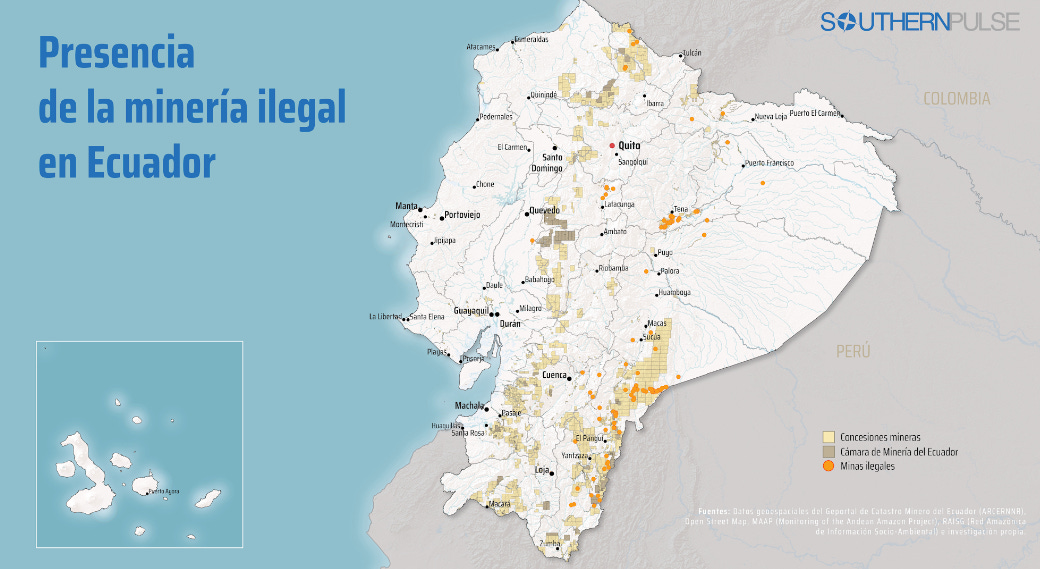
In August 2022, a company called Rockgolden S.A.S. submitted an export certificate to Ecuadorian authorities declaring it had processed 4,588 metric tons of gold ore in 13 days at the DENIS UNO concession in El Oro province. It reported extracting 43 kilograms of pure gold, sold to a company in Dubai for USD2.2 million. The certificate was approved without inspection. A legal mining company with 200 employees told investigators it could process roughly 40 tons per day. Rockgolden claimed to have processed nine times that volume with no verified workforce, no visible equipment, and no evidence that mining had ever taken place at the site.
By the end of 2023, Rockgolden had exported USD71 million in gold to MHGS Trading DMCC in Dubai — roughly 70 times its exports the year before. Alongside Rocadorada and Soul Metals, it shipped USD268 million to the UAE and India from concessions that existed only on paper. All three were founded in 2021. At USD5,000 per ounce, a single falsified export certificate of the kind Rockgolden filed in 2022 would today be worth nearly three times what it was then.
Rockgolden was a product of design. In 2020, Ecuador introduced the simplified joint stock company (SAS) framework — requiring USD1 in capital, a single owner, and no background checks. By 2021, family groups in the coastal provinces of El Oro and Guayas had begun registering SAS companies with mining commercialization licenses. Rockgolden, Rocadorada, and Soul Metals were all founded that year. Guillermo Bolaños, a Peruvian national, ran Rockgolden. Shaheen Daniel Hays, a US national, was listed as shareholder — and separately as managing partner of Metals House Inc. in Peru, the parent company of Rockgolden’s Dubai buyer, MHGS Trading DMCC. Neither responded to journalists.
The regulatory gap that made Rockgolden possible had a name: ARCOM, Ecuador’s Mining Regulation and Control Agency, shuttered in 2020 and not reinstated until August 2024. Its successor approved Rockgolden’s production certificates and export permits without verifying whether mining had occurred at the declared concessions.
Fernando Benalcázar, Ecuador’s former vice minister of mining, documented the collapse. “Companies began to be created without any verification, and could practically export whatever they want without any limits,” he told investigators. The result: 56 companies with no traceable mining operations exported more than USD1.3 billion in gold from Ecuador.
That gold flowed into the same international market that absorbed Venezuela’s sovereign reserves. Where the BCV shipped 113 tons to Swiss refineries that recast sovereign bars into anonymous ingots, Rockgolden shipped fabricated production certificates to Dubai buyers who asked no questions about provenance. The scale differed. The architecture did not. At USD5,000 per ounce, the 56 phantom exporters’ USD1.3 billion in questionable gold would today represent more than USD3 billion.
In May 2025, 11 Ecuadorian soldiers were killed in an ambush during anti-mining operations in the Amazon — a reminder that the administrative architecture Rockgolden exploited does not exist in a vacuum. The phantom certificates that moved USD268 million to Dubai required a supply chain: illegal mines controlled by armed groups, ore trucked hundreds of kilometers to processing plants in Portovelo, and a regulatory apparatus too hollowed out to distinguish real production from fabricated paperwork.
On 19 April 2024, Jorge Maldonado — mayor of Portovelo, mining businessman, the man who understood this pipeline better than any politician in Ecuador — was shot dead on a sidewalk by two men on a motorcycle. He was the fifth Ecuadorian mayor assassinated in a year. Los Lobos, the gang affiliated with Mexico’s Jalisco New Generation Cartel that earns an estimated USD43 million annually from gold extraction and extortion, operates at the physical end of the same chain whose administrative end Rockgolden occupied.
What Rockgolden’s experience exposes is that gold laundering is administrative. A company that never mines a gram can export tens of millions because the global gold market verifies documents, not dirt. Rockgolden operated the retail version of the same architecture Venezuela’s central bank used at the sovereign level. Both exploited the same design feature: once gold enters the certification pipeline, origin becomes irrelevant. At USD5,000 per ounce, every falsified certificate is worth nearly three times what it was when Rockgolden was founded. The incentive to manufacture paper trails has never been greater — and the architecture that processes them has never been less capable of telling the difference.
Rockgolden S.A.S. still appears in Ecuador’s corporate registry. Its export certificates — approved without inspection, from concessions where investigators found no evidence of mining — moved USD71 million in gold to Dubai in a single year. The regulatory agency that should have caught it was shuttered. The mayor who understood the pipeline it fed was murdered. The soldiers sent to disrupt the supply chain were ambushed. And the gold itself, like the 260 tons that left Venezuela’s central bank vaults, has long since been absorbed into a market designed to forget where it came from.
The machinery that processed Venezuela’s sovereign reserves and Rockgolden’s fabricated certificates is one system — built to erase origin, indifferent to whether the gold it handles was mined by a state, stolen by a regime, or invented on paper by a company that never broke ground. At USD5,000 per ounce, that machinery has never been more valuable to those who feed it, or more dangerous to those who stand in its way.
Whether it’s Ecuador or elsewhere in Latin America, Southern Pulse has the experience, network, and relationships to answer your most challenging strategic questions