
The Vanishing Vault
How Venezuela's central bank fed 260 tons of sovereign gold into the same laundering infrastructure used by criminal organizations across South America

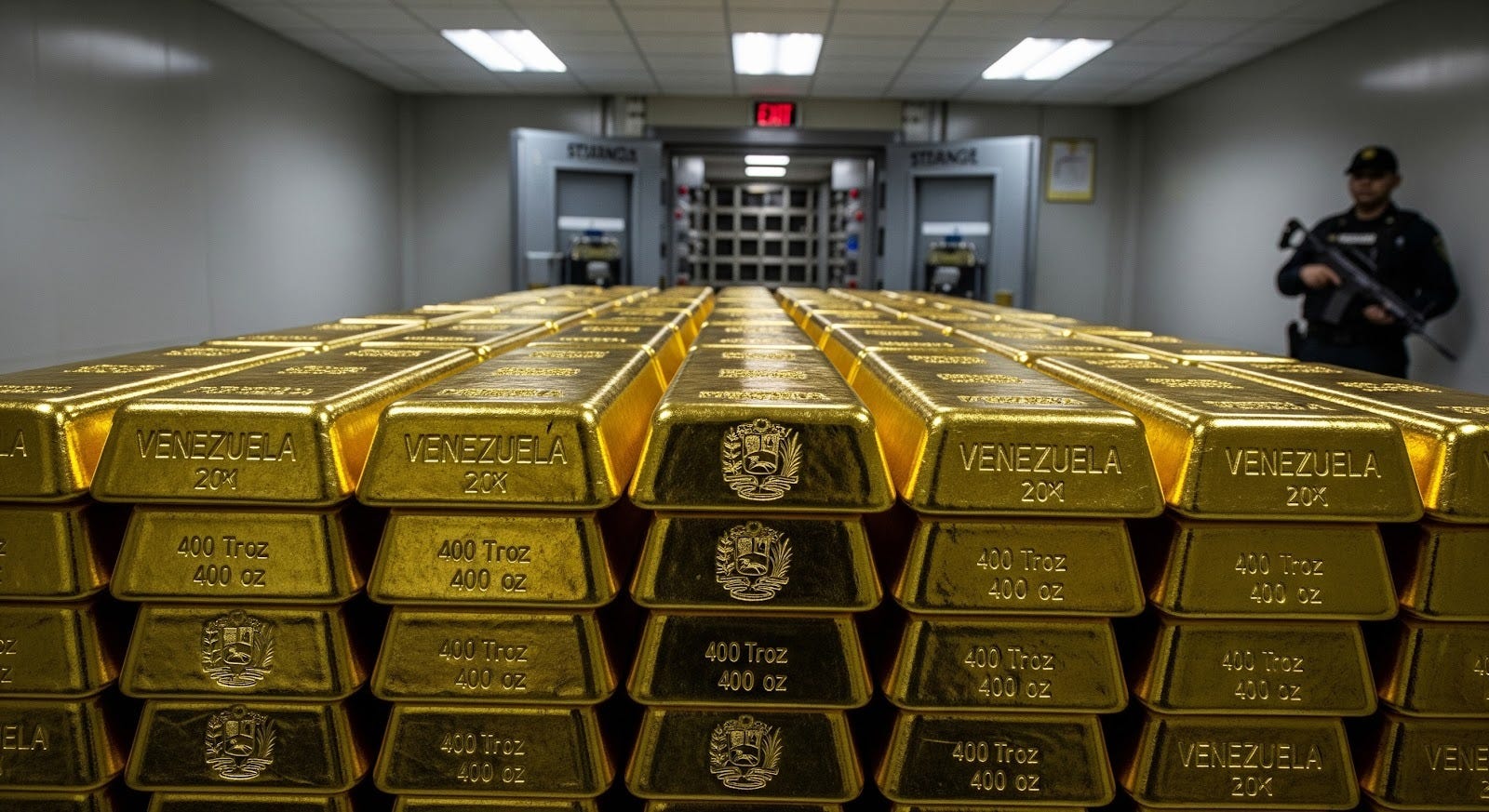
On 25 November 2011, a convoy of armored trucks rolled through cheering crowds in Caracas, escorted by 500 soldiers, tanks, and military aircraft. Inside were the first of 15,000 gold bars — wrapped in black plastic, each weighing roughly 12.5 kilograms — freshly arrived at Maiquetía International Airport from vaults in London, New York, and Zurich. Their destination: the Banco Central de Venezuela (BCV). “It’s coming to the place it never should have left,” President Hugo Chávez declared on national television.
By January 2012, the BCV held roughly 314 tons of gold domestically — the largest reserves in Latin America. Chávez called it a sovereign guarantee against Western financial turbulence. Fourteen years later, the BCV holds approximately 53 tons. The roughly 260 tons that left those vaults between 2013 and 2024 were not stolen in any conventional sense. They were refined in Switzerland, certified in Turkey, absorbed in the UAE, and reportedly shipped to Iran — processed through the same opaque network of refineries and intermediaries that criminal organizations across South America use to launder billions in illicit gold. At today’s price of USD5,000 per ounce, those missing tons would be worth more than USD40 billion.
Hugo Chávez died in March 2013. His successor, Nicolás Maduro, inherited full vaults and collapsing oil prices. With crude falling from USD100 per barrel to USD35 by early 2016, and oil accounting for 95% of government revenue, the BCV’s gold became Caracas’s last source of hard currency. Between 2013 and 2016, the central bank shipped 113 metric tons — worth USD5.2 billion at the time — to Switzerland, according to customs data analyzed by Reuters. The gold landed at refineries in the canton of Ticino, where it was melted, recast into internationally tradable “Good Delivery” bars, and sold onward. Once recast, the bars carried Swiss certification, not Venezuelan origin. The BCV’s sovereign reserves entered the global market scrubbed of their identity — the same process that transforms illegally mined gold from across South America into untraceable commodity.
When European Union sanctions tightened in 2017, the Swiss route closed. The BCV pivoted east. The private Turkish firm Sardes Kıymetlı Madenler signed a sales agreement directly with the central bank, and the Ahlatçı Group’s refinery in Çorum began processing Venezuelan gold. In January 2019, Tareck El Aissami — then vice president for economic affairs, sanctioned by Washington since 2017 for alleged narcotics trafficking and links to Hezbollah — visited the Çorum refinery in person, even as US officials warned Turkey against handling Venezuelan bullion. In 2018 alone, the BCV exported 73 tons — eight times Venezuela’s declared annual production. The surplus flowed onward to the UAE and, according to a Lloyd’s of London alert, to Iran via Mahan Air flights linked to the Islamic Revolutionary Guard Corps (IRGC).
By early 2019, international pressure sealed the Turkish route too. Then-Senator Marco Rubio warned from Miami: “Think about it very carefully. The law is clear. You will face severe sanctions if you allow Nicolás Maduro to steal the gold that doesn’t belong to him, but to the people of that great country.” Inside the BCV, 20 tons sat weighed and separated, ready for shipment — but the transaction was abandoned after staff feared prosecution. Another 31 tons remained frozen at the Bank of England. The vaults Chávez had filled to assert sovereignty had become a stranded asset — too toxic for anyone to touch, too depleted to matter.
What the BCV’s experience reveals is not a story of theft but of infrastructure. The gold that left Venezuela’s vaults moved through a system whose core function is to erase origin — Swiss refineries that recast sovereign bars into anonymous ingots, Turkish intermediaries that certified and redirected them, Gulf markets that absorbed them without provenance questions. This is the same architecture that transforms illegally mined gold from across South America into clean commodity. The BCV did not operate outside the laundering system. It operated through it, because at scale, no alternative exists. The global gold market is built to forget where metal comes from. For a sanctioned regime selling reserves to survive, that amnesia was a feature, not a flaw.
The deeper irony runs back to the vaults themselves. When Venezuela’s gold sat in London and New York, it was protected by the institutional frameworks Chávez most distrusted — custodial agreements, counterparty oversight, the legal architecture of Western central banking. Moving the gold required documentation, approval, and visibility that made unilateral liquidation difficult. By repatriating 160 tons to Caracas, Chávez removed those constraints in the name of sovereignty. He eliminated the friction that would have slowed precisely the kind of sell-off Maduro later executed. The repatriation did not protect Venezuela’s gold. It made the gold available to a regime that treated national reserves as a personal liquidity facility — and fed them into a laundering architecture that ensured they could never be recovered.
The BCV’s vaults in downtown Caracas — the same vaults where soldiers deposited black-wrapped gold bars to cheering crowds in November 2011 — today hold roughly 53 tons. Another 31 sit frozen in London, inaccessible. In January 2026, Swiss authorities froze assets linked to Maduro and 36 associates, days after his capture by US forces. But the 113 tons that passed through Swiss refineries a decade earlier are long gone — recast, certified, sold, untraceable.
What Chávez repatriated to protect from Western seizure, Maduro fed into the very system designed to make gold anonymous. The BCV’s experience is not an anomaly. It is a template — one that operates at every level of South America’s gold economy, from sovereign reserves to artisanal mines to shell companies exporting ore from concessions that exist only on paper. At USD5,000 per ounce, the incentive to feed that machinery has never been greater — and the architecture to do so has never been more refined.
Whether it’s Venezuela or elsewhere in Latin America, Southern Pulse has the experience, network, and relationships to answer your most challenging strategic questions